
AL ZUBARAH
The Pearling Epoch: Qatar’s Lustrous Legacy
Few epochs in Qatar’s history stand out as prominently as the pearling era. This chapter intricately weaves tales of bravery, enterprise, and cultural evolution, painting the nation’s path long before the black gold era.

Ancient Ties to the Sea
For more than 2,000 years, ancient mariners and traders have traversed Qatar’s coastlines. Historical manuscripts from the Greek and Roman eras praise the Persian Gulf’s luminous treasures, with Qatar being identified as a central hub in the vast global pearl network.
Economic Linchpin of a Nation
In the years before the 20th century and the arrival of oil exploration, pearling was Qatar’s primary income source. During the hot months of June to September, many men venture out to sea searching for the shining pearls beneath. The traditional Qatari boats, known as Dhows, would sail for months in pursuit of these precious treasures.
A Social Mosaic Shaped by Pearls
The pearling industry had a substantial impact on Qatar’s society. Wealthy merchants funded the dangerous expeditions, while experienced captains navigated the dhows. The divers were at the forefront of the pearling fleet, and they were supported by a crew responsible for tasks such as maintaining the boats and carefully evaluating the quality of the pearls.
The Ebbing Tide of Pearling
Like every other historical era, the Pearling period also ended. During the 1930s, the world was hit by a severe economic depression, which harmed luxury trades such as pearl trading. Around the same time, Japan’s Mikimoto Kōkichi brought cultured pearls, a safer and more affordable alternative to natural pearls. Additionally, the 20th century marked the discovery of oil in Qatar, which changed its economic and social course forever.

Modern Reverence for a Bygone Era
The legacy of the pearling age holds a significant place in Qatar’s identity. Al Zubarah, an archaeological landmark situated on the country’s shores, has been recognized by UNESCO as a tribute to the historical grandeur of the pearling town. Even today, Qatar’s present-day culture, which blends modernity and heritage, acknowledges the importance of the Pearling era as a connection between its thriving present and its illustrious past.
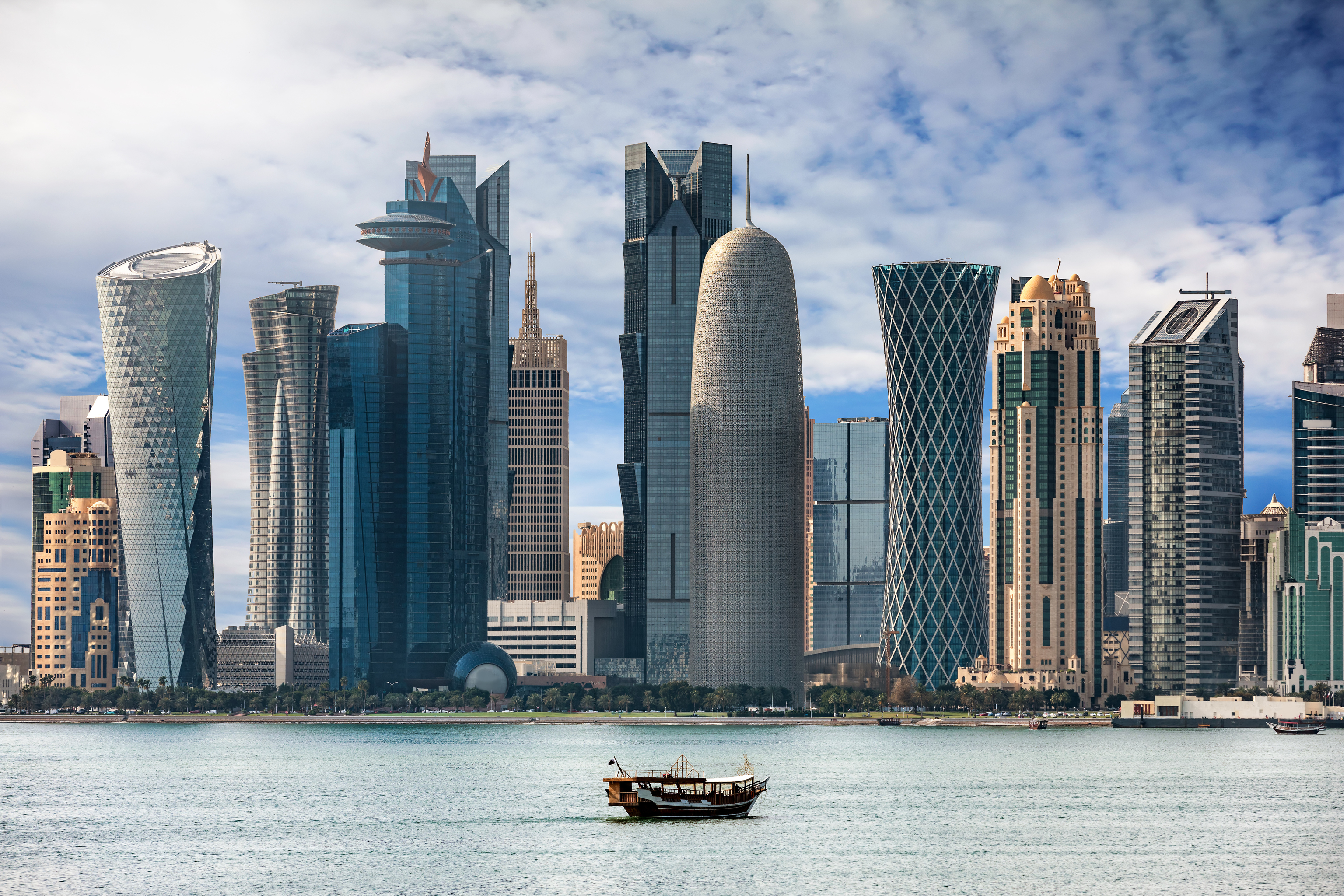
DOHA
Doha, founded in the 1820s and officially designated as the capital of Qatar in 1971, following the country’s independence from British protectorate status, is located on the eastern coast of the Persian Gulf, south of Al Khur and north of Al Wakrah.
This city is home to most of Qatar’s population (2.688 million in 2021), accommodating over 80% of the nation’s residents in the town and its neighboring suburbs.

HISTORICAL NOTE
In 1918, the conclusion of World War I also marked the end of the Ottoman Empire, which had ruled over Arab territories for four centuries. As a result, new countries were created from the remains of the Ottoman Empire. However, these newly formed nations were mainly shaped to serve the interests of Western imperialism, particularly France and Britain, rather than the local population.
FOUNDATIONS OF SPORT
In 1958, Sheikh Jassim bin Hamad Al Thani took on the role of Qatar’s inaugural Minister of Education. During his time in office, he laid the groundwork for contemporary sports governance in the country. Sheikh Jassim hired a team of top-notch physical education teachers who incorporated sports into the curriculum, forming school sports teams and inter-school competitions, sparking a love for athletics in Qatar’s younger generation.
Doha Stadium
In 1958, Sheikh Jassim bin Hamad Al Thani took on the role of Qatar’s inaugural Minister of Education. During his time in office, he laid the groundwork for contemporary sports governance in the country. Sheikh Jassim hired a team of physical education teachers who incorporated sports into the curriculum, forming school sports teams and inter-school competitions, sparking a love for athletics in Qatar’s younger generation.
In 1962, the Doha Preparatory and Secondary School unveiled the Gulf’s first-ever grass football pitch, which was later transformed into a stadium with player facilities and spectator stands, and was named the Doha Stadium.
The national stadium, which opened in 1962, became the home of Qatari sport and hosted the annual Youth Sports Festivals and top matches of the Qatar League and Amir Cup.
In 1971, legendary boxer Muhammad Ali fought an exhibition against Alonzo Johnson at the stadium, and in 1973, Pelé and his Brazilian club Santos played local side Al Ahli there, winning 3-0.
A Global Leader in Sport
Over the last 60 years, Qatar has undergone a sporting transformation. Today, Qatar welcomes the world to spectacular sports events and sends its male and female athletes to compete at the elite international level. Through its investment in state-of-the-art facilities and use of sport for social development – at home and abroad – the country has become a global leader in sport.
Qatar is becoming one of the 21st century´s leading sports nations. It hosts annual events in tennis, golf, equestrianism, handball, and volleyball, as well as many regular and one-off competitions.
But this is only the start. The government is committed to creating a world-leading sports infrastructure and training facilities. Its stadium building program for the FIFA World Cup Qatar 2022 has set new standards in ensuring its venues meet the highest levels of green design and energy efficiency.
On and off the sporting field, Qatar sets itself the highest standards. And, as the world of sports continues to change, Qatar aims to be one of the nations that leads it to change for the better.
A New Era for Sport in Qatar
During the 1960s and 1970s, many of Qatar´s sports clubs and federations were established, representing a range of modern sports. With the support of the Government, the federations nurtured the country´s sports scene and increased the talent pool. Their contacts with sporting bodies in other countries helped to put Qatar on the sporting map.
Foreign coaches, like the Belgian decathlete Freddy Herbrand, were also invited to help raise the standard of competition and advise on the creation of Qatar´s sporting facilities. The sport’s popularity was growing, as was Qatar’s appetite to host international competitions.
Qatar’s Olympic Journey
The formation of the Qatar Olympic Committee in 1979 and its recognition by the International Olympic Committee in 1980, were critical milestones in Qatar´s Olympic journey. They were also part of its nation-building process, following independence in 1971.
Qatar´s ambitions to join the global Olympic community began even earlier. The Youth Sports Festivals of the 1960s featured Olympic-style parades and podiums. The first name for Qatar’s new stadium, “Khalifa Olympic Stadium” (1976-1992), was a clear statement of intent.
Qatar´s participation in international sporting events was a commitment to sport and an expression of its national sovereignty. The accreditation of the country´s sports federations by international bodies, such as FIFA, was a source of national pride that helped to unite the country.
Timeline
1956 – Qatar´s Scout Association is founded.
1958 – Doha Stadium is built at Doha Preparatory and Secondary School.
1959 – First Youth Sports Festival.
1961 – Qatar Athletics Federation is established.
1962 – The first grass football pitch in the Gulf region opens at Doha Stadium. Qatar Handball Federation is established.
1962 – Qatar Volleyball Association was founded.
1963 – Qatari Football League creates the First Arab School Games, Kuwait.
1964 – Qatar Basketball Federation is established.
1970 – 1st Arabian Gulf Cup.
1971 – Qatar becomes independent, and the national flag is adopted.
1971 – Muhammad Ali x Alonzo Johnson at Doha Stadium.
1972 – The government reorganizes sports clubs.
1972 – The Amir Cup is founded.
1973 – Pelé´s FC Santos from Brazil play Qatar´s Al Ahli.
1976 – Khalifa Stadium opens for the 4th Arabian Gulf Cup.
1977 – Qatar wins the Gulf Cross Country Team Championship.
1979 – the Youth Welfare Supreme Council created the Qatar Olympic Committee.
1981 – Qatar is runners-up in the FIFA World Youth Championships, Australia.
1984 – Qatar first competes in the Olympic Games
1985 – Faraj Marzouk wins gold at Pan Arab Games.
1989 – Salem Al Mansoori wins AHF Bowling World Cup, Dublin
1992 – Qatar wins the 11th Arabian Gulf Cup.
1992 – Barcelona Olympics: Mohammed Suleiman becomes Qatar´s first Olympic medalist.
1993 – Talal Mansour becomes Qatar´s first athletics world championships medalist at the IAAF World Indoor Championships, Toronto.
1993 – First ATP Qatar Open, Khalifa International Tennis and Squash Complex.
1994 – First ITTF Qatar Open
1996 – Qatar´s first participation in the Paralympics.
2001 – Qatar Women’s Sports Committee is established.
2001 – First WTA Qatar Ladies Open
2004 – Qatar wins the 17th Arabian Gulf Cup
2004 – Aspire Academy for Sports Excellence is established.
2005 – Qatar Sports Investments is set up to support sports development at home and abroad.
2006 – 15th Asian Games, Doha.
2007 – The Qatar School Olympic Programme is set up.
2008 – Qatar National Vision 2030 is launched.
2008 – Qatar bids to host the 2016 Olympics, but is not shortlisted.
2009 – 2nd FIG Artistic Gymnastics World Cup, Doha.
2010 – Qatar wins a silver medal at Singapore’s inaugural Youth Olympic Games.
2010 – The Women’s National Football Team is formed.
2011 – Qatar Peace and Sport Cup.
2011 – The Arab Games includes Qatar´s first women’s basketball tournament.
2011 – AFC Asian Cup, Qatar.
2011 – Nasser Al Attiyah wins the Dakar Rally.
2012 – The Women’s Basketball League is launched.
2012 – First National Sports Day: 14 February.
2012 – Creation of the Qatar Women’s Football League, which today has seven clubs.
2012 – London Olympics. Qatar sends four female competitors.
2012 – Qatar bids to host the 2020 Olympics, but is not shortlisted.
2013 – First CHI Al Shaqab (showjumping dressage and endurance event)
2015 – IPC Athletics World Championships, Doha.
2015 – 24th Men’s Handball World Championship.
2016 – Rio Paralympics: shot putters, Sara Masoud and Abdulrahman Abdulqadir, wins silver.
2019 – IAAF World Athletics Championships, Doha.
2021 – Tokyo Paralympics: Abdulrahman Abdulqadir wins bronze for the men’s F34 shot put.
2022 – FIFA World Cup Qatar 2022.
2030 – 21st Asian Games, Doha.
ASPETAR AND 3,2,1
Doha also holds Aspetar, the Gulf region’s premier Orthopaedic, and Sports Medicine Hospital, delivering the utmost medical care for sports-induced injuries, and the 3-2-1 Qatar Olympic and Sports Museum, a national and international sports history, heritage, and knowledge center, promoting and encouraging academic research. It is also a member of the Olympic Museum Network, which currently unites 22 Olympic museums worldwide.
YET TO COME
Qatar’s commitment to sports is evident in its diverse athletic talent and infrastructure investments. This dedication has transformed the nation from a peripheral global sports player to a hub that has hosted numerous international tournaments, including the FIFA World Cup in 2022.
The extensive timeline highlights the milestones achieved and reflects a clear vision grounded in the national ethos.
With each passing event, Qatar continues to push the limits of what is possible in the world of sports. As the global sporting landscape evolves, Qatar is poised to remain at the forefront, leading changes, setting benchmarks, and inspiring millions. Based on Qatar’s sporting journey, there is much anticipation for the future, ensuring that the best is yet to come.