
First impressions
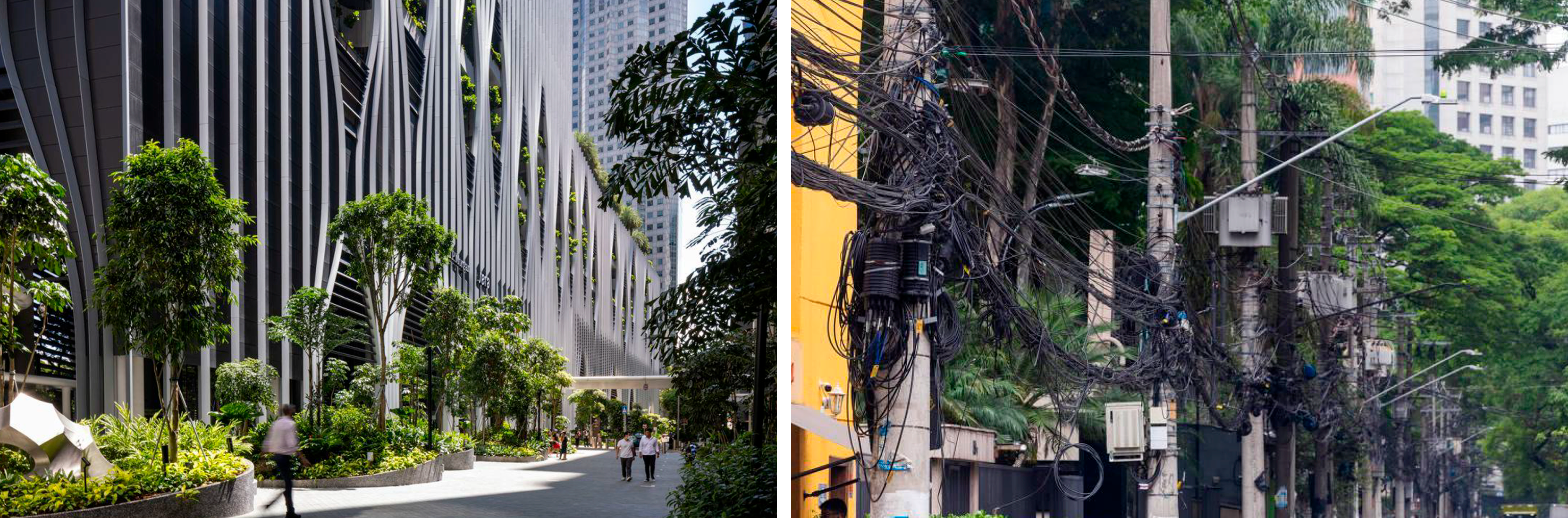
When I arrived in Singapore, what caught my eye was the city’s impressive skyline intertwined with greenery everywhere—a striking example of urban life and nature in true harmony.
Singapore’s leaders have long recognized that rapid urbanisation and high-density living, if not thoughtfully managed, could erode quality of life. Recognizing these challenges, policymakers understood that economic growth alone would be incomplete without a focus on liveability.
Unlike Singapore, Brazil has lacked a unifying long-term vision. Instead, its path has frequently been shaped by political corruption and missed opportunities to advance the common good. As the saying goes, a picture is worth a thousand words. The visuals below highlight the stark contrasts between Singapore and Brazil (🇸🇬 Strong planning, clean governance — 🇧🇷 Weak planning, systemic corruption)


Singapore’s initiatives:
As skyscrapers and housing blocks rose, the government recognised that a harsh, concrete urban landscape could take a psychological toll and erode residents’ quality of life. To address this, they launched the Garden City campaign in 1967—a bold and strategic effort to plant over 55,000 trees and weave greenery throughout the city.
…
I was born in 🇧🇷 in 1974, seven years after Singapore launched its Garden City campaign.
Living in Brazil in 2010—long before I knew anything about Singapore’s history—I started to consider how an ordinary citizen might contribute to their community. It became clear to me that, in the Brazilian context, government action alone could not overcome the challenges we faced, and that society’s deeper issues were far too complex for any single person to address alone.
Determined to take action and make a meaningful difference, I decided to start locally, within my own neighborhood. This resolve marked the beginning of Plantando Ruas (Planting Streets)—a project devoted to replanting every tree on my street and ensuring each one was placed correctly and thoughtfully cared for. By improving my own street, I hoped this gesture would inspire my neighbors to do the same.

According to the broken windows theory, visible signs of disorder—like broken windows, graffiti, or neglected public spaces—signal that no one is paying attention, encouraging further disorder and eventually more serious crime. The idea is that minor problems, if left unaddressed, create an environment where antisocial behavior feels tolerated. By quickly fixing minor damage and maintaining order, we can help discourage escalation, strengthen social norms, and promote a sense of safety.
Alongside planting trees, I took on other challenges in the neighborhood: painting over graffiti, removing illegal advertisements, and fixing damaged sidewalks. These small upkeep gestures, guided by the broken windows theory, were meant to build a sense of order and pride on the street (the picture below shows the same initiative I carried out in Belo Horizonte, Brazil, and implemented in Madrid, Spain).

Then, something remarkable happened: a few neighbours began to join in. One day, as I was tending to the trees, I noticed someone standing beside me. Without looking up, I heard a voice: “So you’re the one responsible for all this change. I really wanted to meet you.” It was Mr Jaime, a retired man from another building. From that day forward, he would look out for me from his window, and whenever he saw me on the street, he’d come down to help. Little by little, what started as a solo effort began to foster a sense of community.
On another afternoon, a deliveryman paused to watch me planting. He looked confused and eventually asked if I was fulfilling a court-ordered community service sentence. When I smiled and explained that I was doing it voluntarily, his demeanor shifted instantly. ‘Well,’ he said, returning the smile, ‘if you ever need a hand, I’d be glad to help.
Experiences like these showed me that when someone takes the first step with genuine intentions, it can break down barriers and bring people together. Even in places where effective leadership is missing, people are eager to rally around positive examples and work towards something better.
Reflections
On my most recent visit to Singapore, I spoke with a local who reflected on growing up hearing leaders say, “Citizens live their lives—the government takes care of the rest.”
That approach certainly created stability, and under the strong leadership of Lee Kuan Yew, it was likely necessary for Singapore’s development. But I’ve always felt that a society truly flourishes only when people are involved, not just governed. When the state does everything, it risks dampening the spirit of shared responsibility.
That is why I find Singapore’s current shift so compelling. The new leadership is embracing a model that encourages everyone to contribute. As Prime Minister Lawrence Wong recently said, “If each of us does our part for the ‘we’… then the ‘me’ will thrive and flourish too.” It’s an inspiring vision of a society built on mutual support, even if the practical steps are still unfolding.
Singapore’s Evolution: 1967 to 2025
Singapore began with physical order. In its early years, the focus was purely functional. Campaigns such as the Garden City (1967) and Keep Singapore Clean (1968) initiatives were designed to make the city livable. Once the environment was secured, the government shifted focus to social behavior, launching the National Courtesy Campaign (1979) to manage the stresses of high-density living.
However, as the city matured, leaders realized that a clean, polite city wasn’t necessarily a happy one. In the 1990s and 2000s, the focus shifted inward. Initiatives like the National Kindness Movement and the Renaissance City Project acknowledged that humans need culture and meaning, not just clean streets.
Today, there is an increasing focus on mental well-being and collective responsibility. Initiatives like the National Mental Health Blueprint and the recent Happiness Initiative recognize that, despite substantial economic progress, prosperity alone does not guarantee happiness. Perhaps genuine happiness depends on the “Kampung spirit”—that same sense of community I discovered with Mr. Jaime on a street in Brazil.
A Timeline of Transformation
- Garden City Campaign (1967): A bold strategy to plant over 55,000 trees to soften the “concrete jungle,” recognizing that greenery is essential for reducing the psychological toll of urbanization.
- Keep Singapore Clean (1968): A foundational campaign focused on hygiene and public health to instill a sense of national pride.
- National Courtesy Campaign (1979): As density increased, this aimed to smooth social friction and encourage politeness in shared spaces.
- National Health Survey (1992) & Great Singapore Workout (1993): Recognized the link between physical health and mental well-being, introducing mass community exercise.
- Family Values (1994): Addressed the erosion of extended support networks by codifying values like “Love, Care, and Mutual Respect.”
- National Kindness Movement (1997): An evolution of the Courtesy Campaign, moving beyond manners to fostering genuine benevolence and social cohesion.
- National Mental Health Blueprint (2007): The first significant step toward integrating mental healthcare into the community, reducing reliance on hospitals.
- Our Singapore Conversation (2012–2013): A massive dialogue involving 47,000 citizens, revealing a public desire for “Purpose” and “Spirit” over pure economic gain.
- Action Plan for Successful Ageing (2015): A shift toward “confident ageing,” ensuring seniors remain socially connected rather than isolated.
- National Steps Challenge (2015): Gamified physical activity to combat sedentary lifestyles, indirectly boosting mental health through movement.
- Happiness Initiative (2017): A social enterprise shifting the narrative from external success to sustainable well-being, democratizing the “science of happiness” through community workshops and evidence-based tools.
- National Mental Health and Well‑Being Strategy (2023): A comprehensive plan establishing mental health as a key national priority, expanding support networks in schools and workplaces.
- Age Well SG (2023) & Grow Well SG (2025): Targeted strategies to support mental and physical wellness at both ends of the spectrum—seniors and children.
- Integration of Mental Health into Healthcare (2025): The most recent push to treat mental health with the same rigor as physical health, including new protocols for anxiety and depression in primary care and the launch of the National Mental Health Helpline.
Good points. One day I’ll explain how to prevent graffiti artists from covering up my new construction projects. It’s another example of coexistence.